
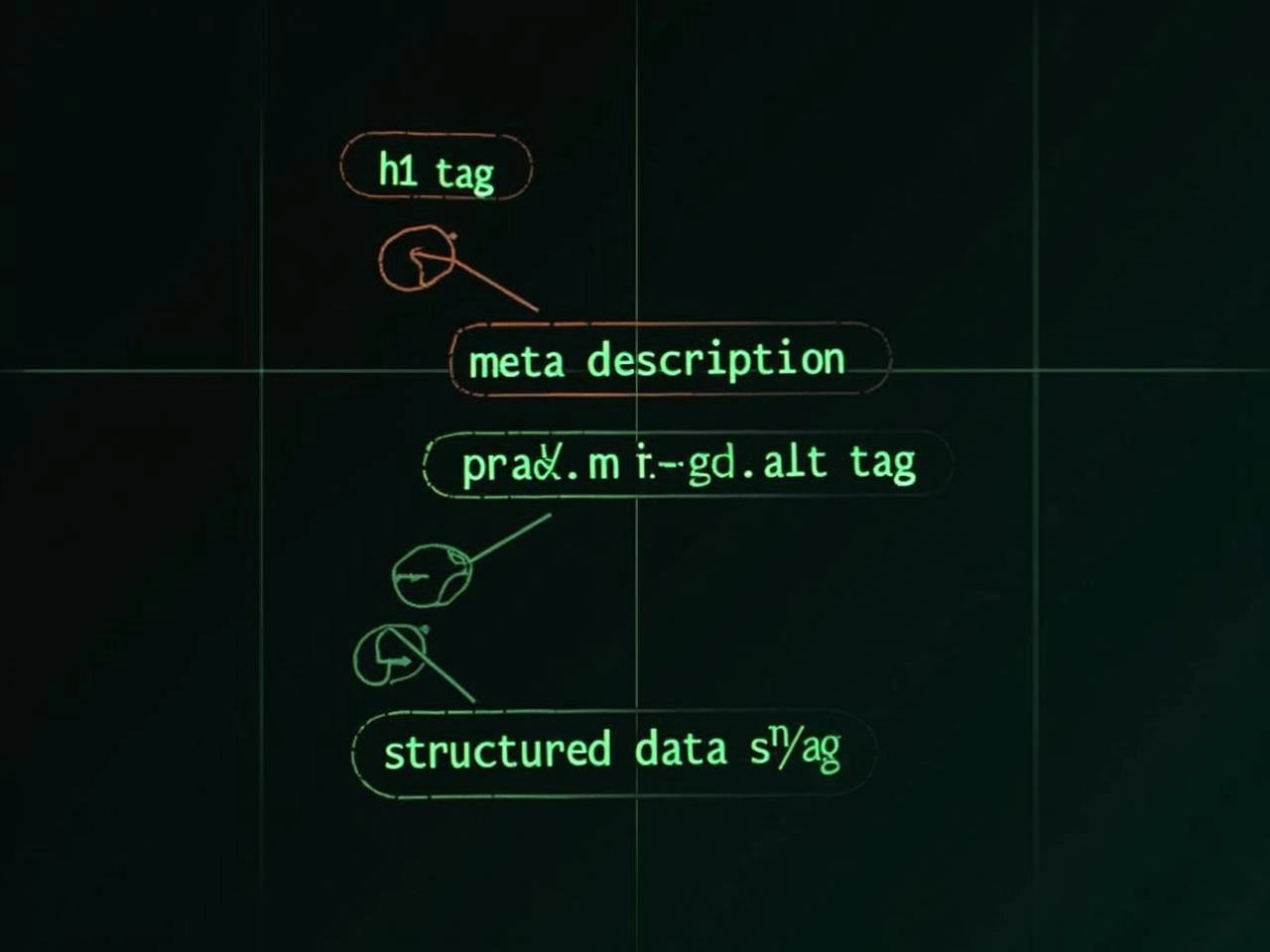
On-page SEO refers to optimizing the content and HTML source code of a specific page to rank higher and earn relevant traffic. The foundational basics involve optimizing Title Tags, Meta Descriptions, H1 and H2 headings, content quality, and image alt text. These elements provide direct signals to search engine algorithms and AI Overviews, confirming the page’s relevance and topic authority.
1. Title Tags and Meta Descriptions
These two components are the first impression of your page in the SERPs, directly influencing click-through rate (CTR).
- Title Tag (The Hinge): Must include your primary target keyword, be compelling, and stay between 50-60 characters. It is the most important on-page ranking signal.
- Meta Description (The Pitch): Should be a concise, engaging summary (120-130 characters) that supports the title and provides a clear call-to-action or value proposition.
2. Content Quality and User Intent Matching
Content is the heart of on-page SEO. It must comprehensively answer the user’s query—known as matching search intent.
Structuring Content with Headings (H1, H2, H3)
A logical heading structure is vital for both human readability and AI comprehension.
- H1: One H1 per page, mirroring the topic and containing the primary focus key phrase.
- H2: Major sections of the article, breaking down the main topic.
- H3: Subsections that elaborate on the H2 points, providing granular detail.
This clear hierarchy allows AI Overviews to quickly extract and synthesize the key answers.
3. Image Optimization (Visual Content)
Images add context and break up large blocks of text, but they must be optimized for speed and accessibility.
- Alt Text: This describes the image for visually impaired users and search engines. It must be descriptive and integrate relevant keywords naturally.
- File Size and Format: Compress images and use modern formats (like WebP) to prevent them from slowing down your crucial Core Web Vitals.
4. URL and Internal Linking Structure
The URL slug should be short, descriptive, and contain the target keyword. Internal linking is the practice of hyperlinking to other relevant pages on your own site.
- Anchor Text: Use descriptive anchor text (e.g., “local citation strategies”) rather than generic phrases (e.g., “click here”) to pass context and authority to the linked page.
Q&A Section
Q: What is ‘Keyword Stuffing’ and why is it harmful?
A: Keyword stuffing is the practice of unnaturally overloading a page with keywords in an attempt to manipulate rankings. This creates a poor user experience and is a violation of Google’s quality guidelines, leading to potential penalties.
Q: Should I use my primary keyword in the first paragraph?
A: Yes, it is a best practice to use your primary keyword naturally within the first 100 words of the body content. This immediately reinforces the topic to both the reader and the search engine algorithm, aligning with the front-loaded introduction strategy.
